24 Hour Service Hotline:0769-22710188 / 13713357162



With the rapid development of new material technology, Metal Organic Frameworks (MOFs) have become the "star materials" in the fields of adsorption separation, energy conversion, gas storage, etc. due to their unique porous structure, ultra-high specific surface area, and controllable chemical properties. As a company deeply engaged in surface treatment and functional material research and development, we have always been concerned about breakthroughs in the application of MOFs materials in the fields of environmental protection and energy. Starting from the core application areas, we will analyze the technical value and industrial potential of MOFs materials, providing reference for technological upgrades in related fields.
1、 MOFs materials: structural characteristics lay the foundation for diverse applications
MOFs materials are formed by self-assembly of metal ions (or metal clusters) and organic ligands through coordination bonds, and their core advantages lie in:
Ultra high specific surface area: Some MOFs materials have a specific surface area of over 7000 m ²/g, which is equivalent to one gram of material covering the area of one football field, providing sufficient "space" for adsorption and storage;
Structural designability: By adjusting the types of metal ions and organic ligands, the pore size (0.3-10 nm) and surface chemical properties can be customized to meet different scene requirements;
Excellent stability: Most MOFs materials can maintain structural stability at high temperatures (200-400 ℃) and in acidic and alkaline environments, meeting the harsh conditions of industrial applications.
These characteristics enable MOFs materials to exhibit performance advantages far beyond traditional materials in areas such as adsorption separation, catalytic reactions, and gas storage, making them a key carrier for promoting technological upgrades in multiple industries.
2、 Core application areas of MOFs materials: multidimensional breakthroughs from environmental protection to energy
(1) Adsorption and Separation Field: Efficient Purification, Supporting Environmental Governance
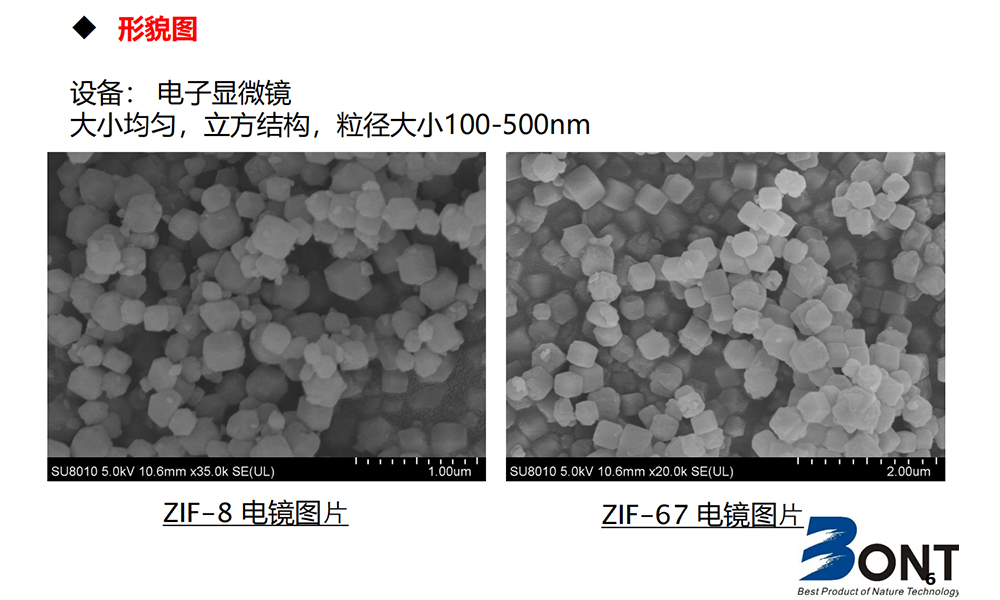
The "gate opening" effect and surface superhydrophobicity during the adsorption of isobutanol by ZIF-8 preferentially penetrate alcohol macromolecules to prevent water molecules in the high-performance ZIF-8 nanocomposite film.
ZIF-8 exhibits 4-10 times higher adsorption performance for VOCs than traditional adsorption materials such as activated carbon and molecular sieves, and shows excellent adsorption performance for organic and exhaust gases.
ZIF-8 also has potential application value in purifying wastewater. The adsorption of phthalic acid in wastewater is achieved through both electrostatic and acid equilibrium processes, with an actual adsorption capacity of up to 654 mg/9.
(2) Water oxidation and photocatalyst field: driving green energy conversion
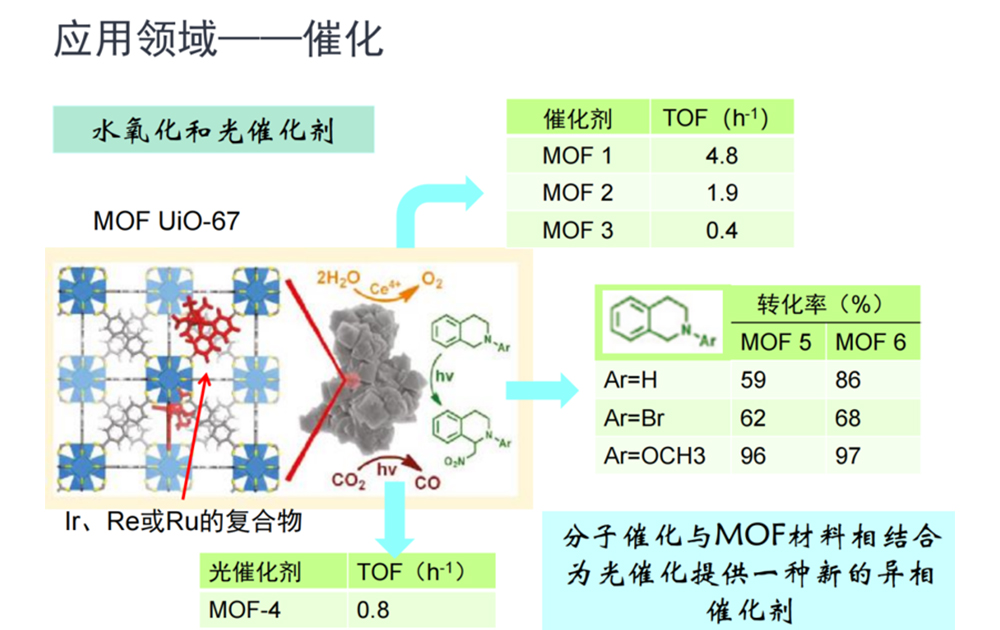
Driven by the "dual carbon" goal, MOFs materials have become the core materials for green energy technologies such as hydrogen production through water oxidation and photocatalytic degradation due to their excellent catalytic performance
Water oxidation catalysis: MOFs materials can efficiently catalyze the water oxidation reaction (oxygen production step) in water splitting by regulating metal active sites (such as Fe, Co, Ni based MOFs). The catalytic efficiency is 3-5 times that of traditional metal oxide catalysts, providing key support for photocatalytic hydrogen production and electrolysis of water for hydrogen production technology, and assisting in the large-scale production of clean energy;
Application of Photocatalysts: By combining MOFs materials with semiconductors such as TiO ₂ and g-C ∝ N ₄, an efficient photocatalytic system can be constructed. Under visible light irradiation, MOFs materials can quickly absorb light energy and transfer electrons, achieving photocatalytic degradation of organic pollutants such as dye wastewater. At the same time, CO ₂ can be reduced to fuels such as methanol and formic acid, realizing the dual value of "pollutant treatment+energy conversion";
Strong catalytic stability: The skeleton structure of MOFs materials can protect the active sites from corrosion, and the catalytic efficiency remains above 80% even after more than 50 cycles of use, significantly reducing the application cost of catalytic technology.
(3) Gas storage field: empowering efficient utilization of clean energy
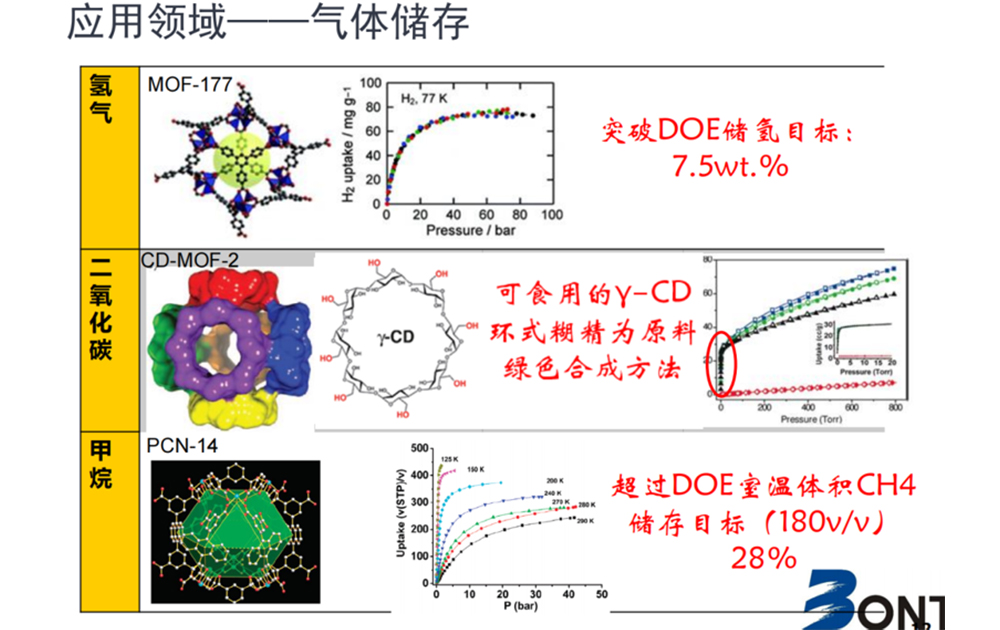
The high specific surface area and controllable pore size of MOFs make them an ideal carrier for clean energy storage such as natural gas (CH ₄) and hydrogen gas (H ₂), solving the pain points of traditional storage technologies such as high pressure hazards and low capacity
Hydrogen storage: MOFs materials can achieve efficient adsorption of hydrogen at room temperature and medium low pressure (1-10 bar) conditions, with a storage capacity of 7-9 wt% (far exceeding the 3-4 wt% of traditional high-pressure steel cylinders), and have fast adsorption/desorption rates, suitable for hydrogen storage needs in fields such as hydrogen vehicles and fuel cells;
Natural gas storage: For the storage of natural gas for vehicles, MOFs materials can reduce the storage pressure of natural gas from 200 bar to 35 bar, while increasing the storage capacity by 20%, reducing the manufacturing difficulty and safety risks of gas cylinders, and promoting the popularization of natural gas vehicles;
Special gas storage: MOFs materials can also be used for the storage of gases such as ammonia (NH3) and carbon dioxide (CO ₂), such as storing ammonia as slow-release fertilizer in agriculture and storing CO ₂ in carbon capture to achieve resource utilization.
3、 The synergistic value of MOFs materials and surface treatment fields
As a company specializing in surface treatment technology and material research and development, we deeply recognize the potential application of MOFs materials in the field of surface treatment. For example, in metal surface pretreatment, MOFs materials can be used as efficient adsorbents to remove heavy metals and organic pollutants from degreasing wastewater and phosphating wastewater, improving wastewater reuse rate; In the field of functional coatings, MOFs materials can be compounded into coatings, endowing them with dual functions of "adsorption purification+catalytic degradation", and adapting to the surface protection needs of high-end equipment and electronic devices.
In the future, we will continue to focus on technological breakthroughs in MOFs materials, explore their integration and innovation with surface treatment processes, provide customers with more environmentally friendly and efficient surface treatment solutions, and help the industry achieve the dual goals of "green production+technological upgrading".
Conclusion
Metal organic frameworks (MOFs), with their unique structure and properties, are causing technological changes in areas such as adsorption separation, energy catalysis, and gas storage, providing a new path for environmental governance and clean energy utilization. We will closely follow the development trend of MOFs materials, combine with the application needs in the field of surface treatment, promote the industrialization of new material technology, and inject new momentum into the high-quality development of the industry.
If you need to know the specific application solutions of MOFs materials in the field of surface treatment, you can visit our official website for more technical information or contact our R&D team for customized consultation.



bontzzz
0769-22710188
徐小姐:13712980628 / 张先生:13713357162
zzz@bont.cn
广东省东莞市万江街道泰新路551号

 WeChat
 Request Samples
 Home
Home